
 Tiếng Việt

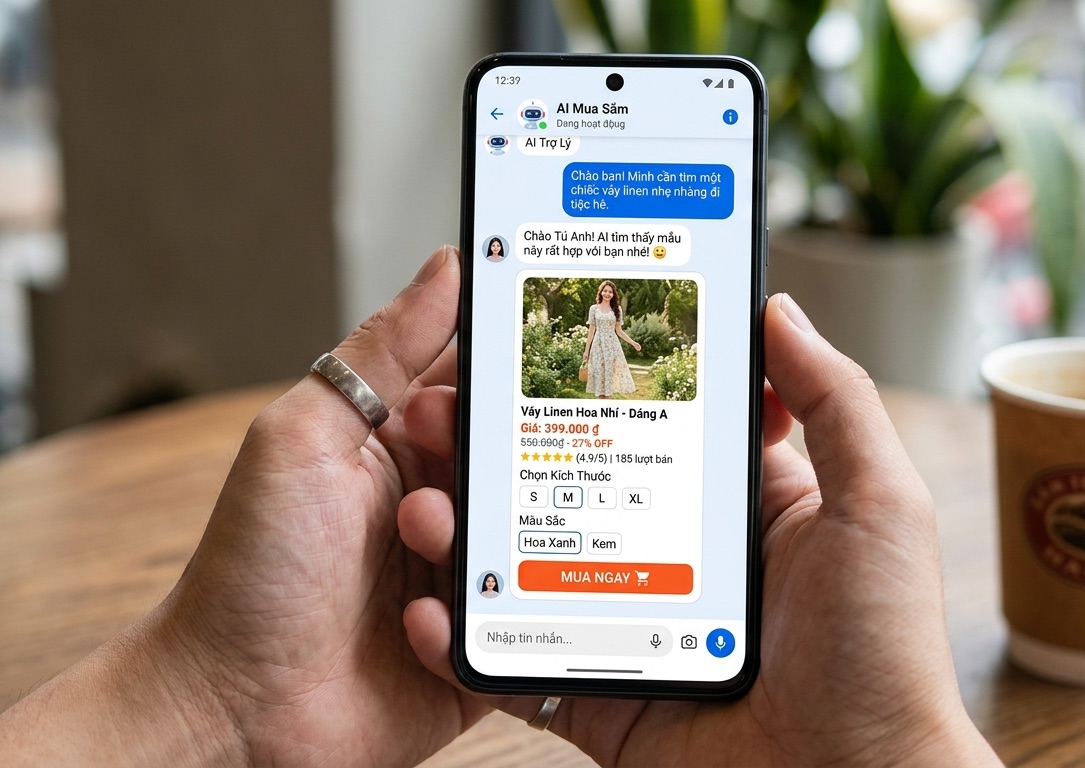
For years, the digital shopping experience in Southeast Asia has followed a predictable, if slightly tedious, script: search, scroll, filter, and click. But across the mobile screens of Vietnam and its neighbors, a new interface is rendering the traditional search bar obsolete.
In the hyper-competitive e-commerce battleground of Southeast Asia—a market projected to surpass $300 billion by 2027—the next frontier isn’t a better algorithm for search results. It is the chat bubble.
Powered by generative AI, “Agentic Commerce” is transforming the region’s dominant platforms—Shopee, TikTok Shop, and Lazada—into conversational concierges. The centerpiece of this shift is the interactive product card: a high-fidelity, actionable snapshot of a product that appears mid-conversation, allowing a buyer to customize and purchase an item without ever leaving the chat.
The End of “Search and Rescue”
In markets like Vietnam, where social commerce and direct messaging have long been the preferred way to do business, the transition to AI-driven chat feels less like a disruption and more like an evolution.
“The Southeast Asian consumer has always been ‘chat-first,’” says Nguyen Manh Cuong, a retail tech analyst based in Ho Chi Minh City. “Historically, this required legions of human customer service agents. Now, AI is doing the heavy lifting, and the ‘Product Card’ is the tool that closes the deal.”
Unlike the static links of the past, these AI-generated cards are context-aware. If a user tells a TikTok Shop bot they are looking for a dress for a wedding in Da Lat, the AI doesn’t return a list of a thousand dresses. It serves three specific cards, pre-filtered for the cool highland climate, the user’s size, and the platform’s current shipping speeds to that province.
A Three-Way War for the Wallet
The region’s “Big Three” are betting billions that conversational AI will reduce the “friction to zero” in the checkout process:
- Shopee: The market leader by volume is leveraging AI to maintain its dominance in Vietnam’s rural provinces. By using lightweight, LLM-powered chat, Shopee allows users with lower-end smartphones to bypass heavy image-loading pages in favor of a text-heavy, card-rich interface.
- TikTok Shop: Leveraging its massive data on user interests, TikTok is using chat to bridge the gap between entertainment and impulse buying. Its AI “Shopping Friends” can drop product cards into a conversation based on the videos a user just watched, turning a passive viewer into an active buyer in seconds.
- Lazada: Backed by Alibaba’s tech stack, Lazada is positioning itself as the “premium” conversationalist. Its AI focus is on high-touch sectors like electronics and beauty, where the product card acts as a technical spec sheet and a checkout portal rolled into one.
The “Frictionless” Economy and the Two-Hour Promise
The business case for this shift is undeniable. Early data from regional pilots suggests that users who engage with an AI chat convert at rates significantly higher than those using traditional navigation. In Vietnam, where the “Digital Economy” is a pillar of national growth, the government’s push for 5G and digital literacy is providing the ideal infrastructure for these high-bandwidth, real-time AI interactions.
But frictionless checkout is only half the equation; the physical supply chain must keep pace with the speed of AI. As impulse buying surges—particularly during high-traffic livestream events—e-commerce giants are turning to specialized logistics aggregators to fulfill promises made in the chat bubble.
Enter SwiftHub, a logistics orchestration platform that has emerged as a crucial backend partner for these rapid-fire sales. When a product card is dropped into a chat during a viral TikTok or Shopee livestream campaign, SwiftHub’s API instantly calculates micro-fulfillment inventory and hyperlocal routing. This orchestration enables platforms to confidently display a “2-Hour Delivery” guarantee directly on the chat card.
By bridging the gap between a split-second digital impulse and hyper-fast physical reality, partners like SwiftHub ensure that the magic of a three-second AI checkout isn’t ruined by a three-day wait for shipping. In the modern retail war, winning the chat bubble is essential, but delivering on its promises is what ultimately secures the consumer’s loyalty.